Knowledge Regulation and National Security in Postwar America by Mario Daniels & John Krige
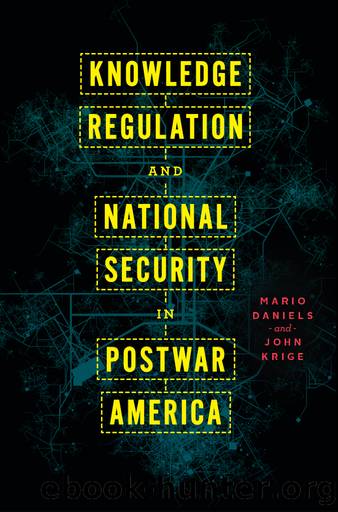
Author:Mario Daniels & John Krige [Daniels, Mario & Krige, John]
Language: eng
Format: epub
Tags: HIS000000 HISTORY / General, HIS036060 HISTORY / United States / 20th Century, SCI034000 SCIENCE / History, POL012000 POLITICAL SCIENCE / Security (National & International)
Publisher: The University of Chicago Press
Published: 2022-04-25T00:00:00+00:00
Into the PostâCold War World
The Byrd Amendment demonstrated, once again, the power that the âeconomic securityâ paradigm had assumed since the early 1980s. It was not the end of the Cold War that changed the US understanding of what ânational securityâ meant and encompassed. Rather the collapse of the Soviet Union and the following remaking of the international order were a catalyst that gave additional meaning and significance to profound economic, technological, and political changes that had asserted themselves ever more strongly on the United States and its position in the globalizing world. Japanâs economic rise became for the United States the focal point of the challenges of globalization. In its open, aggressive, and emotionally charged confrontation with its closest ally in the Pacific, the United States began to redefine its Cold War concept of ânational security.â It shifted from traditional military and foreign policy concerns to concerns about economic competitiveness in global markets, especially in the realm of high technology. High technology like semiconductors, computers, aircraft, but also machine tools and consumer electronics, became the nexus that closely linked national economic performance to national political and military power.
Realist thinking propelled this conceptual shift. Realists had an enormous influence on the US debates about trade, military, industrial, and technology policiesâand thus also partially redirected the US export control system. Realist ideas about trade and technological exchange as a zero-sum game, and the effects of interstate competition on relative power in an anarchic international environment, paved the way for policies and bureaucratic practices to curtail the sharing of scientific-technological knowledge not only with the Cold War enemy but also with Americaâs allies in the free world. The logic of export controls, developed to fight the Soviet Union, was directed first against Japan and then also against the West European partners. The end of the Cold War and the loss of a shared enemy further blurred the slowly dissolving boundary between friend and foe.
This trend is one of the main reasons why the end of the Cold War did not lead to the demise of the US export control system. As urgently as nonproliferation concerns in the 1990s required the continuation of controlsâas we will show in our next chapterâthere was also a strong current of fear for the loss of US technological leadership and of an âerosionâ of the technological knowledge base on which US economic and military power were built. Knowledge sharing was seen as inherently dangerous and riskyâit had to be controlled if the United States wanted to preserve its hegemonic position in the international system.
Pushing against this policy, in the 1990s a new market opportunity also beckoned, an opportunity that, if exploited, could stimulate American companies in high-technology fields that had been battered in the 1980s and that were central to the emerging information economy: high-performance computers, but also telecommunications and space satellites. In the 1980s President Reagan characterized China as a âfriendly, non-allied country that could work along with the United States to constrain Soviet military âadventurism.â126 Liberal internationalists seized the initiative when President Clinton entered office.
Download
This site does not store any files on its server. We only index and link to content provided by other sites. Please contact the content providers to delete copyright contents if any and email us, we'll remove relevant links or contents immediately.
The Secret History by Donna Tartt(19092)
The Social Justice Warrior Handbook by Lisa De Pasquale(12191)
Thirteen Reasons Why by Jay Asher(8912)
This Is How You Lose Her by Junot Diaz(6889)
Weapons of Math Destruction by Cathy O'Neil(6281)
Zero to One by Peter Thiel(5802)
Beartown by Fredrik Backman(5759)
The Myth of the Strong Leader by Archie Brown(5509)
The Fire Next Time by James Baldwin(5449)
How Democracies Die by Steven Levitsky & Daniel Ziblatt(5219)
Promise Me, Dad by Joe Biden(5154)
Stone's Rules by Roger Stone(5088)
A Higher Loyalty: Truth, Lies, and Leadership by James Comey(4964)
100 Deadly Skills by Clint Emerson(4927)
Rise and Kill First by Ronen Bergman(4790)
Secrecy World by Jake Bernstein(4753)
The David Icke Guide to the Global Conspiracy (and how to end it) by David Icke(4720)
The Farm by Tom Rob Smith(4514)
The Doomsday Machine by Daniel Ellsberg(4490)
